

At Dimer Health, transitional care is about more than checking in after discharge, it’s about making sure patients never feel alone during recovery. Our Behind the Screens series highlights the clinicians who provide compassionate, continuous support to patients long after they leave the hospital.
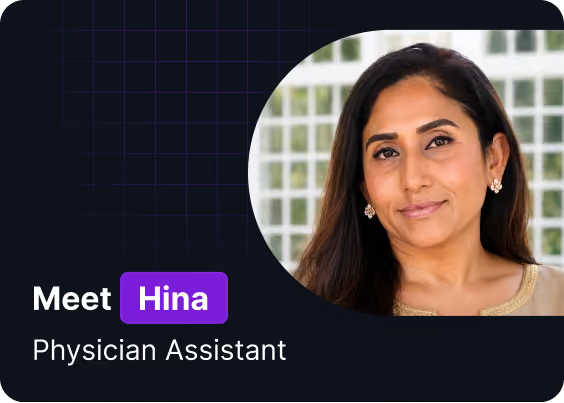
In this edition, we’re spotlighting Hina Rey, PA-C, whose nearly three decades in medicine, spanning emergency medicine, rural healthcare, family practice, neurology, pain management, and urgent care, have shaped her deeply practical, patient-centered approach to care.
A Career Defined by Curiosity and Adaptability
Hina graduated from Rutgers/UMDNJ’s Physician Assistant program in 1998 and has spent the past 28 years caring for patients across a wide range of healthcare settings.
“I’ve always liked learning new things,” Hina shared. “That’s one of the reasons I loved becoming a PA. I can move into different areas of medicine and continue growing.”
Throughout her career, she has worked primarily in emergency medicine while also exploring specialties like neurology, pain management, urgent care, family practice, and rural medicine.
Today, in addition to her work with Dimer Health, Hina practices emergency medicine in the Oklahoma panhandle, where access to care can look dramatically different from what many patients experience in urban areas.
“In some places, the closest doctor may be an hour away, and the closest surgeon could be four hours away,” she explained. “You realize very quickly how important access to care really is.”
Why She Joined Dimer Health
Hina’s connection to Dimer Health came unexpectedly through a conversation with another PA while performing site visits for physician assistant students.
At the time, she was balancing emergency medicine with several side roles but was looking for something more meaningful and sustainable.
“She told me about Dimer and said, ‘You should really talk to them,’” Hina recalled. “And once I understood what Dimer actually does, it just clicked.”
What resonated most was the focus on supporting patients after discharge, a period she saw repeatedly overlooked during her years in emergency medicine.
“In emergency medicine, patients leave with discharge papers and are expected to figure everything out on their own,” she said. “Dimer changes that.”
The Value of Transitional Virtual Care
Although Hina had prior experience with telemedicine, she quickly recognized that Dimer Health’s model was fundamentally different from traditional urgent care telehealth.
“This isn’t just virtual urgent care,” she explained. “We’re helping patients navigate what happens between discharge and their next doctor appointment.”
For Hina, transitional care acts as a bridge, helping patients manage medications, coordinate services, understand discharge instructions, and identify when something may be wrong before it escalates.
“A lot of patients are lost after discharge,” she said. “They don’t know who to call, how to arrange wound care, or how to navigate insurance and services. Having someone there to guide them makes a huge difference.”
She also sees enormous value in virtual care for rural and underserved communities.
“In the Midwest and rural areas especially, this kind of support is critical because many patients simply don’t have easy access to healthcare resources.”
A Patient Interaction That Stayed With Her
One patient interaction that stands out involved a younger woman recovering from a significant hand burn.
Through Dimer Health’s virtual follow-up care, Hina was able to monitor wound healing, assess mobility, and help guide the patient through recovery.
“With hand burns, you have to be very mindful of stiffness and mobility issues,” she explained. “Those are things patients often don’t realize they should even be paying attention to.”
Because specialty burn clinics can be difficult to access quickly, especially for patients outside major cities, having ongoing virtual support created an added layer of reassurance and oversight.
“That’s the beauty of this model,” Hina said. “Patients can reach out and say, ‘I don’t feel right,’ and we can talk through what’s happening before things get worse.”
Why She Chose Medicine
Hina originally planned to attend medical school, but after entering PA school, she discovered a path that ultimately aligned even better with her personality and goals.
“I realized I loved the flexibility of being a PA,” she said. “I can continue learning, trying new specialties, and challenging myself in different ways.”
That adaptability remains one of the things she loves most about medicine today.
“New things excite me,” she shared.
Life Beyond the Screen
Outside of healthcare, Hina enjoys spending time with her family and dog, cooking, traveling, listening to audiobooks, and taking spontaneous road trips.
One of her favorite recent adventures was a road trip down the East Coast with her father and son, who is stationed in Florida with the Air Force.
“It was fun because there was no timeline,” she said. “We just stopped wherever we wanted along the way.”
A fun fact many people wouldn’t guess?
Hina was born in Uganda and moved to the United States as a child after her family fled political unrest.
If she weren’t in healthcare, she says she’d likely be:
An engineer, a field she originally considered before pursuing medicine.
How She Recharges
For Hina, recharging is all about slowing down and spending time at home.
“I like to just relax with my family, my dog, listen to music, or read,” she shared.
Quickfire Round
☕ Coffee or Tea: Tea (especially chai)
🌅 Early Bird or Night Owl: Early bird
🏠 Dream Skill to Master: Becoming a general contractor
🌍 Fun Fact: Born in Uganda
💬 Mantra: “If you put your mind to it, you can do anything.”
💻 Behind the screen, Hina Rey, PA-C, combines decades of clinical experience with compassion, adaptability, and a deep understanding of what patients need most after discharge: guidance, access, and someone who truly stays connected to their recovery journey.