

After a hospital stay, you might hear about hospital at home, home health, post-discharge care, and primary care, but often with little explanation on how they differ. While all four support patients outside of the traditional hospital setting, each serves a distinct purpose at different stages of recovery. This guide explains what each care model does, who it’s for, when it should be used, and how the models work together to help patients recover safely and confidently.
Home health, hospital at home, post-discharge care, and primary care all play important roles in the recovery process. But they are also designed for different purposes. Here’s how you can tell them apart, and understand which care type is best suited to your needs.
The Short Answer: Four Models, Four Different Jobs
Although these care models are often grouped together, they’re also designed to solve different problems.
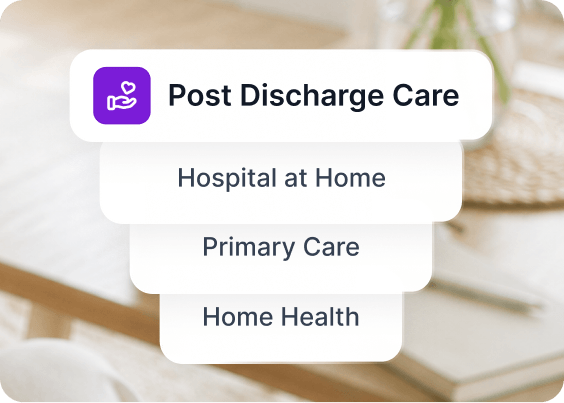
Hospital at home replaces the inpatient hospital stay by delivering hospital-grade treatment in the patient’s home. Home health provides physician-ordered skilled services, such as nursing, physical therapy, or wound care, for eligible patients recovering at home. Primary care manages your overall health over months and years, while post-discharge care focuses on the high-risk period immediately after leaving the hospital, helping patients recover safely, before transitioning back to their primary care provider.
The simplest way to understand the difference is to think about the job each model is designed to do.
The Four Core Models, Defined
Each of these care models is able to support patients outside the traditional hospital setting.h Where they differ, is each program is designed for different stages of patient care. Understanding what each of the models does, as well as what they don’t do, is crucial for choosing the right support during the recovery process.
Post-Discharge Care (Transitional Care)
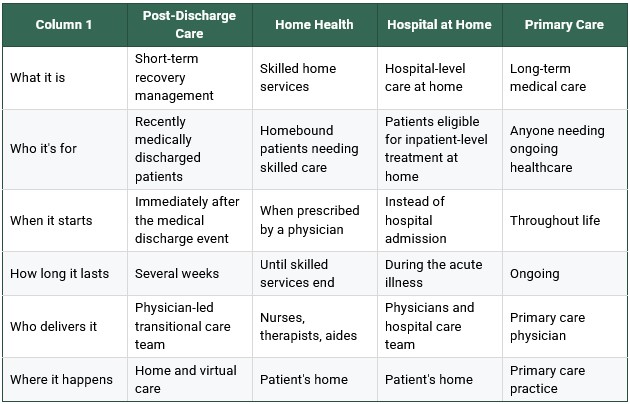
Post-discharge care, also known as transitional care medicine, is short-term clinical support that manages your recovery in the weeks after you leave hospital. The purpose is to bridge the gap between hospital discharge and the return to baseline health and routine care, helping reduce the risk of complications and avoidable readmissions during one of the highest-risk stages of recovery
Unlike long-term healthcare services, post-discharge care is time-limited, and focused on a single goal: helping you recover at home safely. It typically includes medication reconciliation, symptom monitoring, follow-up care coordination, patient education, and ongoing clinical support until you’re ready to transition back to your primary care provider.
Home Health Care
Home health care is skilled, physician-ordered care delivered in a patient’s home, usually by visiting nurses, physical therapists, occupational therapists, or home health aides. It provides clinical services, such as wound care, injections, rehabilitation exercises, mobility training, or monitoring certain medical conditions for those who qualify.
Home health visits are typically intermittent rather than continuous, with clinicians visiting according to a prescribed care plan. While home health professionals play an important role in recovery, they are also focused on delivering the skilled services ordered by your physician ordered by your physician rather than managing every element of your overall recovery or serving as your primary medical provider,
Hospital at Home
Hospital at home delivers acute, hospital-level care in a patient’s home as an alternative to being admitted to hospital. It’s designed for patients who require inpatient-level treatment but are clinically stable enough to receive that care safely at home, supported by daily clinician oversight, remote monitoring, and in-home diagnostics or treatment.
In the United States, hospital at home programs are typically offered through participating hospitals and Medicare-approved initiatives for eligible patients. The key distinction here is simple, hospital at home replaces the hospital stay, while post-discharge care begins once the hospital treatment comes to an end.
Primary Care
Primary care is your ongoing, long-term relationship with a physician who manages your overall health care. Your primary care provider helps prevent illness, coordinates specialist referrals, performs annual wellness visits, and supports your health over months and years, instead of just a single episode.
Although primary care plays a vital role in your long-term wellbeing, it’s not designed to provide intensive, day-to-day support that many patients rely on immediately after leaving the hospital. Instead, post-discharge care and primary care exist together, with patients transitioning back to their primary care providers once recovery is stable.
Hospital at Home vs. Home Health: What’s Different?
These two models are often confused, but they each serve a very different purpose. Hospital at home functions as an alternative to being admitted to the hospital, while home health provides skilled services to help patients recovering at home after a physician orders them.
The biggest difference between the two is the level of care that is being delivered. Patients receiving hospital at home are still experiencing an acute illness that would otherwise require them to be admitted to the hospital. They will receive frequent clinical oversight, ongoing monitoring, and coordinated treatment from a hospital-led care team. Home health patients, by contrast, are generally stable enough to remain at home and receive scheduled visits for specific services, such as wound care, physical therapy, or medication administration.
The two models also differ in terms of who qualifies for care. Hospital at home is available only to carefully selected patients whose condition can be safely managed outside the hospital and is typically offered through participating health systems. Home health typically requires a physician’s referral and is intended for patients who are homebound and need skilled nursing to help with their recovery.
For someone with pneumonia who would typically be admitted to the hospital may receive hospital-level treatment at home through a hospital at home program. A few weeks later, after returning home, the same patient might receive home health visits for physical therapy or wound care if those services are medically necessary.
The simplest way of assessing the difference here is: hospital at home replaces a hospital admission, while home health delivers specific skilled services during recovery.
Post-Discharge Care vs. Home Health: Where They Overlap
It’s easy to see why these two models typically get confused. Both support patients once they have left the hospital, both can take place at home, and both are focused on helping people recover safely. The difference here is that they’re responsible for different areas of the recovery process.
Home health delivers specific skilled services that a physician has ordered, while post-discharge care takes clinical ownership of the recovery journey as a whole. A home health clinician might change a wound dressing, provide physical therapy, or administer injections during scheduled visits. Post-discharge care coordinates the broader recovery, helping patients manage medications, monitor symptoms, understand hospital discharge instructions, schedule follow-up appointments, and know what to do if their condition changes.
These two models are not mutually exclusive. In fact, a lot of patients benefit from both types of support services at the same time. For example, patients recovering from surgery might receive home health visits for wound care, while Dimer Health takes charge of medication reconciliation, monitors symptoms, coordinates follow-up care, and provides ongoing physician-led support throughout recovery.
The easiest way to think about this is that home health takes care of the skilled clinical tasks, while post-discharge care manages the recovery process.
Post-Discharge Care vs. Primary Care: Two Different Jobs
Post-discharge care and primary care are designed to work together, but with a focus on different stages of the patient’s healthcare journey. Primary care is the long game, while post-discharge care focuses on the shorter, high-risk period that occurs right after leaving the hospital.
Your primary care provider is the physician who takes charge of your health over many years. They oversee preventative care, manage chronic conditions, coordinate specialist referrals, and help you stay healthy over the long-term. As an essential part of your care team, they aren’t typically structured to provide the intensive monitoring that many patients require during the early days and weeks after being medically discharged.
Post-discharge care fills this gap. Dimer Health helps patients recover safely during the high-risk period when complications are most likely to occur, through physician-led support, medication reconciliation, symptom monitoring, care coordination, and proactive follow-up. If a patient’s condition changes during recovery, they have a dedicated clinical team to turn to, rather than having to wait for a follow-up appointment.
Once recovery is on track, post-discharge care transitions patients back to their primary care providers with a clear understanding of their recovery. Primary care and post-discharge care are not competing models, but two crucial cogs of the same engine, powering the same patient recovery journey.
Which Type of Care Do You Need?
Choosing the right type of care depends a lot on where you are in your recovery journey. Use the scenarios below to identify which care model is most fitting for your situation.
You Just Had Surgery or a Hospital Stay
If you’ve recently left the hospital, post-discharge care is designed for this stage of the recovery process. It provides physician-led support during the high-risk recovery window, helping manage medications, monitor symptoms, coordinate follow-up care, and reduce the risk of complications or readmission. If you also require skilled services, such as wound care or physical therapy, home health can be provided alongside post-discharge care.
Best fit: Post-Discharge Care
You Need Ongoing Skilled Nursing or Therapy at Home
If your doctor has prescribed wound care, physical therapy, occupational therapy, injections, or other skilled clinical services, home health is likely the right choice. These services are typically intended for patients who are homebound and are delivered through scheduled visits from qualified healthcare professionals.
Best fit: Home Health Care
You Are Sick Enough to Be Admitted but Could Be Treated at Home
Some patients need hospital-level treatment but can safely receive that care at home via a home hospital program. Eligibility is dependent upon your condition and whether your hospital or health system provides this type of program.
Best fit: Hospital at Home
You Need Routine, Long-Term Health Management
For annual check-ups, preventative care, and ongoing healthcare throughout your life, primary care remains your medical home. Once your recovery is complete, your primary care provider takes over, becoming the central point for managing your long-term health care.
Best fit: Primary Care
How Dimer Health Delivers Post-Discharge Care
Post-discharge care is designed to support patients during the recovery window once leaving the hospital. Dimer Health delivers this through a 24/7 physician-led care team that provides clinical oversight, care coordination, and proactive support until patients are ready to return to their primary care provider.
The experience is powered by Dimer Connect, Dimer Health’s connected post-discharge care platform. Dimer Connect brings medical discharge instructions, personalized recovery plans, medication guidance, symptom monitoring, appointment scheduling, and clinical access together in one connected experience, helping patients navigate recovery while giving care teams the visibility to monitor progress, coordinate outreach, and intervene when needed.
Dimer Health patients have access to AiME, Dimer Health’s AI recovery care companion that lives inside the Dimer’s web-based platform. AiME differs from general-purpose AI chatbots because it is informed by the patient’s personal recovery plan, medical history, medications, and care instructions, allowing it to provide personalized guidance throughout the recovery process. Whenever patients’ questions or concerns need human clinical judgment, Dimer Health’s licensed team steps in to provide physician-led guidance and support.
Currently, Dimer Health provides post-discharge care across New York, New Jersey, Pennsylvian, Ohio, North Carolina, Florida, Texas, and California, with licensing being pursued across other states. Dimer Health helps health systems across the United States extend care beyond hospital discharge, contributing to reductions in hospital readmissions.
The Right Care at the Moment in Your Recovery
Choosing between different care models can feel overwhelming, particularly when you’re already recovering from a hospital stay. Understanding the role that each model plays is vital for helping you ensure you receive the right support at the right time, providing greater confidence throughout your recovery journey.
For hospitals, health systems, and providers, the challenge is different. Once a patient leaves the hospital, visibility through continuity of care is more challenging to maintain. Post-discharge care becomes the tool that bridges that gap, by extending physician-led support into the recovery window. This keeps patients connected, reducing avoidable readmissions, and helping ensure a smoother transition back to primary care.
FAQs
What is the difference between hospital at home and home health?
Hospital at home replaces inpatient hospital stay, while home health provides physician-ordered skilled services to patients recovering at home.
Is post-discharge care the same as home health?
No. Post-discharge care coordinate your recovery, while home health delivers specific skilled services such as wound care or physical therapy.
Can I have home health and post-discharge care at the same time?
Yes. A lot of patients receive home health for skilled tasks, while post-discharge care manages medications, symptoms, follow-up care, and overall recovery.
Does Medicare cover hospital at home and home health?
Medicare might cover hospital at home and home health services for eligible patients when they meet the relevant clinical and program requirements.
Is post-discharge care a replacement for my primary care doctor?
No. Post-discharge care provides short-term support after hospital discharge before transitioning you back to your primary care provider.
What is transitional care management (TCM)?
Transitional Care Management (TCM) is a Medicare service that supports patients during the transition from hospital to home to help reduce complications and readmissions.
Who qualifies for hospital at home?
Hospital at home is available to carefully selected patients whose condition can be safely treated at home through participating hospitals or health systems.
How long does post-discharge care last?
Post-discharge care is temporary, and generally continues for several weeks until your recovery is stable, and you are able to return to routine care.
Do I need a referral for post-discharge care?
Referral requirements can vary, but post-discharge care is typically arranged by hospital or healthcare providers before or after medical discharge.
Which type of care is best after surgery?
Post-discharge care is designed for recovery after surgery, with home health added if you also need skilled nursing services.
Does Dimer Health provide home health or post-discharge care?
Dimer Health provides physician-led post-discharge care, helping patients recover safely after hospital discharge through coordinated clinical support.