


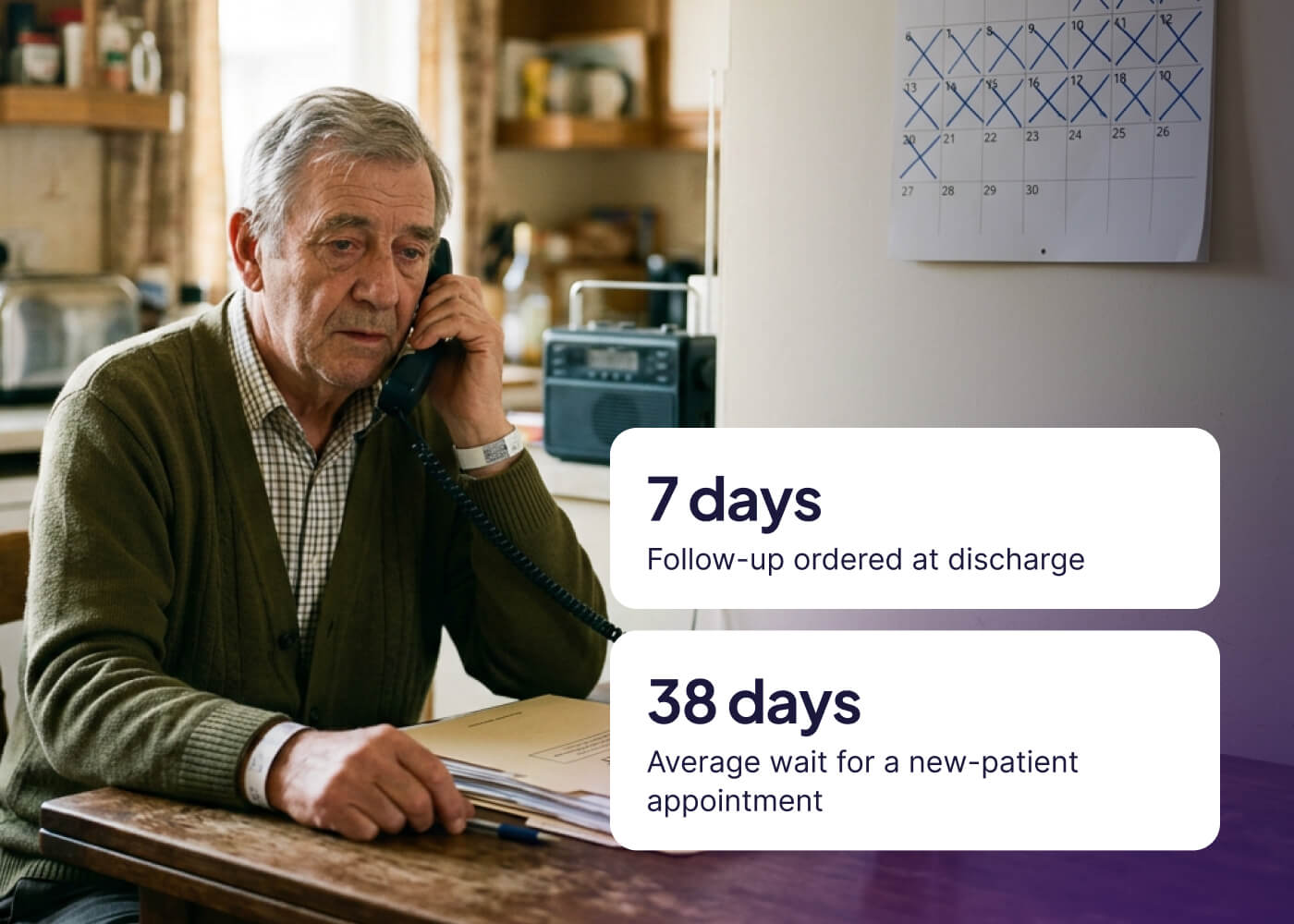
A patient leaves the hospital with instructions to follow up with their doctor within seven days. But what happens when getting an appointment takes weeks?
According to research reported by Becker's Hospital Review, what's the average wait time for a new-patient appointment across common medical specialties?
38 days.
That's more than a month. Research from ECG Management Consultants, covering 11 medical specialties across 23 U.S. metropolitan areas, reveals just how constrained access to outpatient care has become.
While new-patient appointment wait times aren't the same as post-discharge follow-up delays, they expose a larger challenge: Healthcare systems depend on timely outpatient access, even when physician availability is limited.
And for patients recovering from hospitalization or surgery, medical needs don't wait for the next available appointment.
New symptoms emerge. Medication questions arise. Complications develop.
For hospitals and health systems, the challenge isn't simply getting patients discharged with the right instructions. It's ensuring they have access to appropriate clinical care during the days and weeks that follow.
That gap has operational consequences. When patients can't get timely answers or medical attention, their needs often fall back on the hospital or surgical practice that treated them, adding to call volume, stretching clinical staff and potentially disrupting surgical operations.
The Gap Nobody Scheduled For
Discharge instructions are based on a patient's clinical needs, not necessarily the availability of their next outpatient appointment. The follow-up order does not account for how long it actually takes to get in front of any physician, across any specialty.
In most markets, this takes far longer than a week. Hence the 38-day average. For family medicine appointments specifically, metro area wait times run as low as four days in cities like New York and Miami, and as high as 69 days in Boston, according to separate AMN Healthcare survey data reported by the American Academy of Family Physicians.
Nobody built the follow-up system to absorb this. Discharge planning assumes a functioning primary care safety net. And the challenge extends beyond scheduling. Even patients with a confirmed follow-up appointment may experience new symptoms, medication concerns or complications that require medical attention before that visit.
Physician shortages and growing demand for outpatient care only compound the problem. Hospitals can strengthen discharge planning, improve referral processes and coordinate appointments, but they cannot guarantee that an outpatient clinician will be immediately available whenever a patient's condition changes.
57,259. That’s the current physician shortage in the U.S., according to HRSA. Government projections put this number at 81,180 by 2035. The safety net doesn’t have holes. It’s being built with a known shortage baked in.
This means the patient doesn’t simply wait quietly for an appointment. Instead, they are compelled to call somewhere, usually the hospital, surgical practice or clinical team that treated them.
Where the Cost Actually Lands
The consequences of limited post-discharge access don't always appear in a single line item. Instead, they show up across hospital operations, clinical workloads and potentially avoidable utilization.
A patient recovering from surgery calls with a question about their incision. Another patient discharged after a medical admission experiences dizziness after starting a new medication. Someone else develops worsening symptoms but isn't sure whether to contact their primary care physician, specialist or return to the emergency department.
These are common recovery concerns, but they don't always have simple answers. Some require reassurance or education. Others need timely medical evaluation, a treatment adjustment or escalation to a higher level of care.
Without a clear path to clinical support, these concerns can generate additional calls to nursing teams, surgical practices, hospital departments and care managers already balancing significant responsibilities.
This represents a direct hit to surgical throughput, with every interruption representing a small tax on the capacity a surgical program relies on to hit its numbers.
Surgical time has a real, published cost, and it’s a stark one. According to a JAMA Surgery cost analysis of California hospitals, a single minute in the OR costs the health system roughly $37. None of that is billed for answering a phone call about a missed medication dose. Every interruption pulled from that time is not merely an inconvenience, it’s a direct transfer from surgical capacity into unbilled phone triage.
One orthopedic partner saw a 70% reduction in missed OR cases after partnering with Dimer Health.
The consequences extend beyond surgery. When patients can't reach an appropriate clinician, some may turn to the emergency department for concerns that could have been managed in a lower-acuity setting with timely medical evaluation. Others may experience worsening symptoms that lead to preventable complications or readmissions.
The real cost isn't simply the time spent answering a patient's question. It's the clinical and operational consequences when that question doesn't reach the right person at the right time.
The Missing Piece to the Equation: Clinical Responsibility Between Appointments
This isn't a problem hospitals have overlooked. It's one they've been left to manage within a system that doesn't always have the capacity to deliver what discharge plans require.
Primary care wait times are a national access challenge, not something a hospital's discharge team can solve by writing better instructions or making more referral calls. Hospitals can improve their internal processes, but they can't create appointment availability in an already stretched outpatient system.
Ask a hospitalist where their job ends. They’ll say medical discharge. Ask a PCP where theirs begins. They’ll say the appointment three weeks from now. Ask either who owns the space in between, and the answer becomes less clear.
And that's where the equation breaks down.
The patient has a discharge plan, a follow-up recommendation and providers responsible for different aspects of their care. But when an unexpected medical need arises between appointments, who is available to address it?
Patients are left to their own devices, with no assigned owner to deal with their questions, and an already full clinical schedule that means care teams can only field those questions informally.
What Closing the Gap Actually Looks Like
Closing the gap between discharge and follow-up requires more than better scheduling, automated reminders or another patient engagement tool.
It requires a clinical team that can take responsibility for patients' medical needs during recovery, with the ability to assess concerns, initiate treatment and escalate care when necessary.
That's the model Dimer Health was built to provide.
As a physician-led virtual medical practice, Dimer Health assumes defined clinical responsibility during the 30-day post-discharge recovery window, working alongside hospitals, primary care physicians, specialists and existing care transition teams.
Patients typically receive an initial visit within 24-48 hours and have 24/7 access to licensed clinicians who can evaluate symptoms, manage medication concerns and intervene when medical needs arise.
Dimer Connect, our AI-powered discharge and post-discharge platform, helps extend that clinical support between visits. Through personalized recovery guidance, proactive check-ins and AiME, our AI recovery care companion, patients can get answers to everyday questions while staying connected to the clinical team when human judgment is needed.
This combination of proactive patient engagement, AI-supported technology and direct clinical care helps patients get the right level of support at the right time, without requiring hospitals to build additional internal clinical infrastructure.
And when the recovery period ends, Dimer coordinates the transition back to the patient's primary care physician and other longitudinal providers.
The Operational Case for Health System Leaders
For hospital and health system leaders, the consequences of fragmented post-discharge care extend beyond patient experience.
When patients lack timely access to clinical support, emerging concerns can generate additional calls, unplanned visits, avoidable emergency department utilization and hospital readmissions. These demands place additional pressure on care management, nursing and clinical operations teams already managing significant workloads.
Providing medical support during the recovery period can help relieve some of that pressure. Patients have a way to address new symptoms, medication concerns and other medical needs without relying exclusively on hospital staff or waiting for their next outpatient appointment.
The operational impact can be significant. Across its programs, Dimer Health has reported 42% fewer 30-day readmissions, 33% shorter hospital stays among readmitted patients and 3× greater primary care follow-up.
For health systems, these findings point to the value of addressing medical needs earlier in recovery, when timely intervention may prevent complications, reduce unnecessary utilization and allow existing clinical teams to focus their resources where they're needed most.
The Real Question for Health System Leaders
Seven days may be what the discharge instructions recommend. Yet broader physician appointment data shows that access to outpatient care can take weeks.
That disconnect reflects a challenge healthcare organizations cannot solve through discharge planning or scheduling improvements alone.
Patients need more than instructions about when to follow up. They need a clear path to clinical care when questions, symptoms or complications arise during recovery.
For hospital and health system leaders, the question is no longer simply how to get patients to their next appointment.
It's who is responsible for their medical needs in the meantime.
Dimer Health is helping health systems answer that question by extending clinical responsibility beyond discharge, connecting patients to 24/7 medical care and supporting a coordinated transition back to their existing providers.
Sources: