


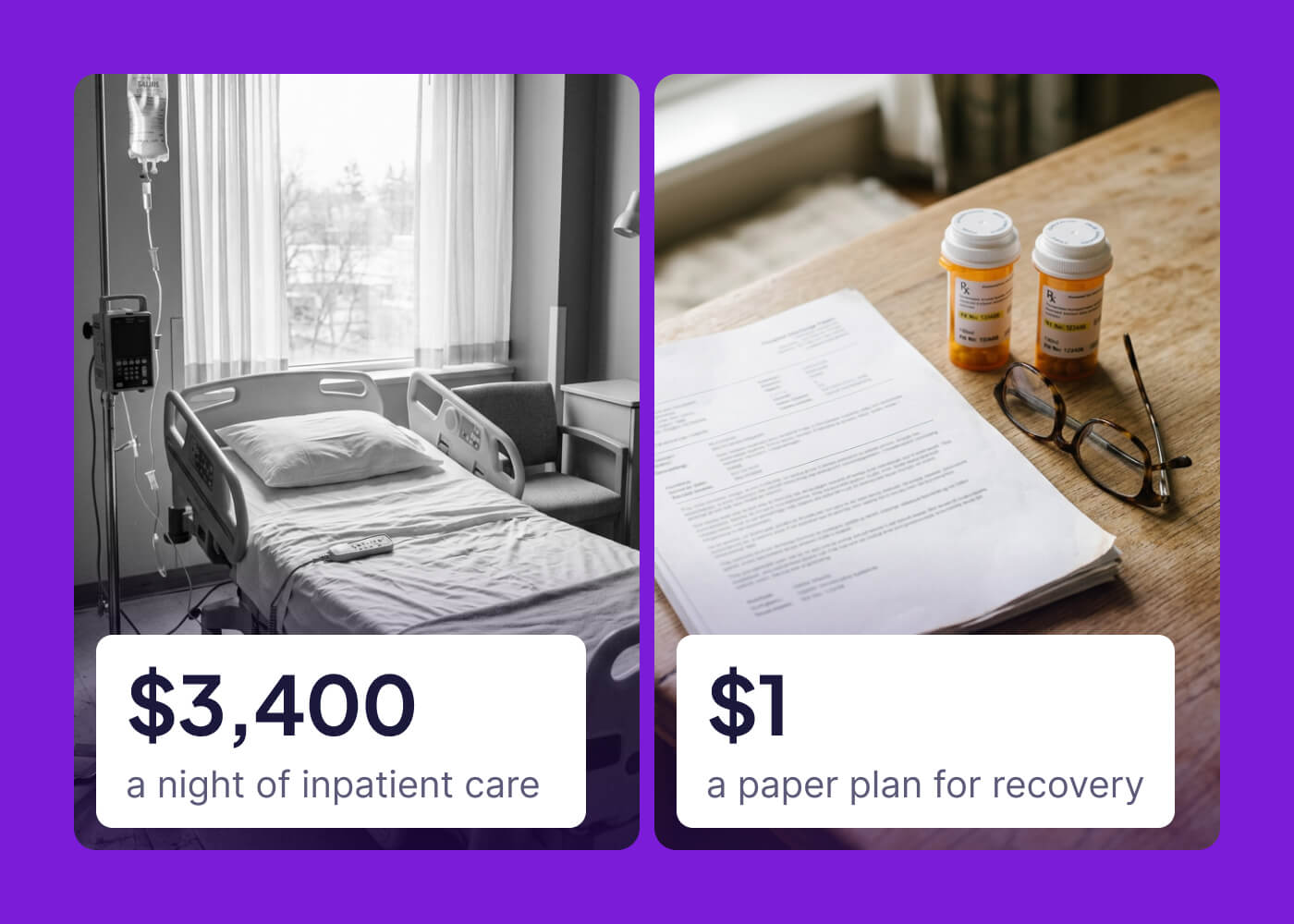
$1. That's less than the price of two postage stamps, and it's what your health system's entire recovery plan is resting on.
Hospitals routinely spend $3,400 a night stabilizing a single inpatient, per 2024 KFF data on non-profit hospital expenses. Surgeons, nurses, imaging, medication, monitoring, days of coordinated clinical care. All of it built to get one patient well enough to go home.
That patient then goes home with a paper packet to carry them through the crucial 30 days that follow.
That packet is tasked with protecting a five-figure clinical investment through the highest-pressure stretch of recovery. In most health systems, it fails.
What happens after a patient leaves the hospital is closer to a black box than a plan. The fallout shows up as denied claims, avoidable readmission penalties, and patients lost to competitors.
This is not a clinical failure. It is an infrastructure failure, and one that can be solved.
The Investment Nobody Protects After Medical Discharge
Every health system has built an empire of operational discipline around the inpatient stay process. Care pathways, rounding schedules, medical discharge planning meetings, case management sign-off. Someone owns a patient’s outcome from the second they set foot inside the hospital.
The moment they leave is when all of that disappears.
The patient, or their caregiver, is left with nothing but a discharge packet to lead them through the fog of recovery. But a discharge packet can’t answer a phone call at 2am when a distressed patient doesn’t know if a symptom is normal. It cannot flag that medication dosage has changed, and explain why. It cannot monitor follow-up appointment schedules, flag that they haven’t been booked, or that it was not booked early enough.
Paper does not triage, escalate, or coordinate, and it cannot connect on a human level. It sits in a folder, in a drawer, while the recovery it was supposed to guide happens without it.
Health systems are not failing to plan for this. They are trying to solve a live, dynamic clinical window using a static, one-time document. The tool doesn’t match the problem, and the mismatch has a price.
What the Gap Actually Costs
The financial exposure that sits inside that post-discharge window breaks down into three distinct areas of exposure, but the majority of finance and quality leaders are only tracking one.
Readmission penalties. Under the Hospital Readmissions Reduction Program, CMS can reduce Medicare payments to a hospital by up to 3% for excess readmissions. But that is also a recurring rate cut not a one-time fine, and it is tied directly to how well a health system manages the recovery window.
Avoidable readmissions themselves. A 2024 meta-analysis published in the peer-reviewed journal Healthcare found that the mean cost for 30-day readmission in the United States is $16,037.08. This is not a hypothetical. It’s the same clinical problem being paid for twice. That’s one cost to fix it, and another because it wasn’t fixed properly the first time.
Referral leakage. When post-discharge communication breaks down, patients don’t always come back to the same health system for follow-up care. They see whichever provider answers the phone or has the next available slot. They look to be valued the same way, whether they are hospital inpatients, or seeking care on the outside.
But there is a fourth issue to consider as well: unbilled Transitional Care Management revenue. TCM billing under CPT codes 99495 and 99496 exist specifically to reimburse the post-discharge coordination work health systems are already doing. Per patient, that reimbursement comes to around $220 and $298 respectively.
This reimbursement often goes uncollected. Providers deliver the care and still miss out because the documentation and timing requirements to collect the reimbursement were not captured.
None of these gaps show up on the same line item. This is precisely why they’re so easy to underestimate in aggregate, and why the real cost of the paper packet era is larger than most organizations have predicted.
Why This Keeps Happening
Inside the hospital, ownership is clear. Then comes discharge.
Clinical teams already know that the first two to four weeks after a hospital discharge mark the most vulnerable stage in the patient care journey. The issue here is structural: nobody designed a role whose full-time job is owning this window.
A hospitalist owns the inpatient stay. Once the patient leaves, that ownership doesn’t transfer anywhere. Primary care will eventually pick the patients back up, but usually not within the seven-day window a discharge order calls for. Average family medicine wait times run closer to 23.5 days, which means there is a measurable gap between when a patient is told to be seen, and when a physician is actually available to see them.
What a Modern Post-Discharge Infrastructure Looks Like
Dimer Connect was built to close exactly this gap, without expecting a health system to rip out or replace anything it already runs on.
It is a white-labeled, post-discharge Transitional Care Medicine platform that gives patients an interactive, web-based recovery companion, accessed directly from their phone. There is no app to download and nothing new for a patient to learn under stress. It shows up as an extension of the health system’s own brand, rather than a third-party tool competing for the patient’s attention.
Underneath it, two things are doing the clinical work. A 24/7 tech-enabled recovery care companion monitors recovery in real time, and handles routine questions immediately, the kind that would otherwise mean a call to a nurse line, or a patient simply trying to guess. Behind that layer sits a licensed clinical safety net: Dimer’s Transitionists, licensed providers whose job is specifically to hold clinical ownership of the recovery window and step in the moment something needs a real medical decision.
This combination shows the difference between a system that reacts to problems after escalation, and one that catches them earlier, when fixing them is not as expensive.
This is a retrofit, not a replacement. Dimer Connect is built to sit on top of existing EMR workflows rather than compete with them. It is not positioned against Epic, Cerner, or any system a hospital has already invested in and trained staff to use.
The Financial Case, Not Just the Clinical One
For CFOs or VPs of Finance, the value of closing this gap is measurable in the same categories the gap currently costs money in.
Reducing avoidable 30-day readmissions protects a health system from HRRP penalty exposure and removes the double-cost of treating the same clinical problem twice. Based on Dimer Health’s own reported outcomes, Dimer Connect is built around a 42% reduction in avoidable hospital readmissions, which turns a recurring financial liability into a controlled, monitored process instead of a guessing game.
Keeping post-discharge communication within the health system’s own branded environment, as opposed to letting a frustrated patient look elsewhere for their next appointment, protects the referral relationship that is being lost to competitors.
And, because Dimer Connect is built with TCM billing requirements in mind from the start, the coordination work clinical teams already carry out has a far greater chance of becoming billable revenue under CPT 99495 and 99496.
None of this requires a hospital to change what its clinicians already know how to do well. It requires giving the post-discharge window the same infrastructure discipline the inpatient stay process has always had.
The Real Question for Health System Leaders
The paper packet was never a strategy. It was an assumption that patients would call if something went wrong, and the assumption that whatever the issue was would happen slowly enough for a scheduled follow-up to catch it.
An expensive assumption to make. And the bill for it lands in readmission penalties, leaked referrals, and TCM revenue that nobody collected.
The real question that should be asked at the next finance meeting is why a $3,000+ per day clinical investment is still being protected by a document that costs less than a cup of coffee, and what it would take to give that window the same level of infrastructure the rest of the hospital stay already has.
You would never run an ICU on a paper packet. Why are we running recovery on one?
Sources: