


Earlier Detection. Faster Escalation. Shorter Readmission Stays.
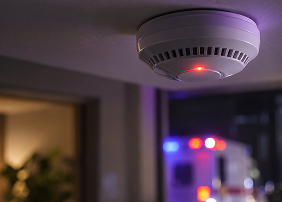
A smoke detector that goes off sooner doesn’t mean your house is more likely to catch fire. It means you’re more likely to know there’s a problem while you can still do something about it. Post-discharge care works much the same way.
For years, we’ve treated readmission as a relatively binary outcome: the patient came back to the hospital or they didn’t. Certainly, avoiding unnecessary readmissions matters. But as an emergency physician, I think that misses an important part of the story. Some patients are going to need to come back.
The goal of good post-discharge care isn’t to keep every patient out of the hospital at all costs. It’s to recognize when recovery is starting to go off course, intervene when we can, and when a patient truly does need hospital-level care, get them there before a manageable problem becomes a much bigger one.
Our latest Dimer Health data give us an interesting window into that. Among patients who ultimately required readmission, Dimer patients returned to the hospital at a median of 7 days after discharge, compared with 11 days among patients without Dimer support.
At first glance, earlier readmission might sound like an outcome we may not want to taut. I think it’s exactly the opposite. These patients had someone actively following their recovery, recognizing deterioration and helping determine when escalation back to the hospital was appropriate. When they returned, they spent a median of 4 nights in the hospital compared with 6 nights among patients without that support.
The progression matters. Recognize deterioration earlier, escalate appropriately, return less sick, and spend less time in the hospital.
Not every readmission represents a failure of post-discharge care. Sometimes the failure is recognizing the need for readmission too late.
Why the first days after discharge matter
Cardiologist Harlan Krumholz coined the term “post-hospital syndrome” to describe the period of generalized vulnerability patients experience after hospitalization. Patients don’t necessarily leave the hospital fully recovered. They may leave sleep-deprived, deconditioned, undernourished, cognitively taxed and trying to navigate new medications, new diagnoses and complicated discharge instructions.
That vulnerability helps explain why the period immediately after discharge is so important. Historically, nearly one in five Medicare beneficiaries discharged from the hospital were rehospitalized within 30 days, often for a condition different from the one responsible for the original admission. More recent work has continued to demonstrate that what happens early after discharge can meaningfully affect that trajectory.
In one large health-system study, patients successfully contacted within 72 hours of discharge had a 7-day readmission rate of 2.91%, compared with 4.73% among patients who were not reached. There is nothing particularly high-tech about a phone call. What matters is that someone was paying attention.
That’s the period Dimer Healthwas built around: the vulnerable days and weeks after discharge, when patients have left the highly monitored environment of the hospital but often haven’t yet reconnected with their traditional outpatient care team.
Scaling the part that works
The challenge is that closely following every patient after discharge is difficult to scale using clinicians alone. Remote patient monitoring has helped generate enormous amounts of information. But more information doesn’t automatically create better care. Someone still has to identify what matters, separate signal from noise and act on it quickly enough to change the patient’s trajectory.
That’s where we believe AI can be particularly useful. Not by replacing clinical judgment, but by helping determine where that judgment is needed.
A recent 2026 preprint examining an autonomous AI triage agent in remote patient monitoring found greater than 95% sensitivity for detecting emergency events, compared with approximately 60% aggregate sensitivity among individual clinicians reviewing the same cases (Kim et al., arXiv, 2026). The technology is still evolving, and findings like these need continued validation. But they point toward what I believe is one of AI’s most practical near-term roles in healthcare: helping clinicians focus their attention on the patients who need them most.
That’s the model behind AiME™, Dimer Health’s AI clinical teammate. AiME operates within Dimer’s clinical model around the clock, informed by the patient’s medical record and discharge plan and connected directly to our clinical team.
When AiME identifies a concerning change in a patient’s recovery, it can escalate that concern to a Transitionist™, the clinician responsible for overseeing that patient’s post-discharge recovery. The clinician then does what clinicians do: reviews the circumstances, talks with the patient, applies clinical judgment and determines the appropriate next step.
Sometimes that means adjusting the recovery plan at home. Sometimes it means arranging additional outpatient care. And sometimes the correct decision is that the patient needs to go back to the hospital. AI helps us recognize the signal, but a licensed clinician decides what to do about it.
A safety net should work in both directions
A successful post-discharge program shouldn’t simply reduce hospital utilization. It should help patients receive the right level of care at the right time.
Patients who can safely remain home should stay home. Patients whose problems can be managed virtually or through coordinated outpatient care should be treated there. But when a patient genuinely needs hospital-level care, keeping that patient home isn’t a success. Recognizing that need early is.
That’s what makes our latest data particularly interesting. Among Dimer patients who ultimately required readmission, the median return occurred 7 days after discharge, compared with 11 days for patients without Dimer support. Once they returned, Dimer patients spent a median of 4 nights in the hospital compared with 6 nights among patients without that oversight.
In other words, patients who needed to return were identified and escalated earlier, and their subsequent hospital stays were shorter.
A pot left on the stove too long doesn't just burn dinner. It takes longer to clean up. Recovery works the same way.
A patient whose deterioration is recognized earlier may arrive before dehydration becomes kidney injury, before a mild infection becomes sepsis, or before a manageable medication problem becomes a larger physiologic setback. Earlier recognition creates an opportunity for earlier treatment, and earlier treatment may mean an easier recovery.
For health systems, the implications are important as well. Two fewer inpatient nights among patients who require readmission means fewer occupied bed-days, lower utilization and additional capacity for patients who need hospital-level care. That benefit comes on top of the readmissions that effective post-discharge care can prevent altogether.
What success actually looks like
We didn’t build Dimer with the expectation that no patient would ever return to the hospital. That’s neither realistic nor necessarily good medicine. We built Dimer because the period immediately after discharge remains one of the least supported parts of a patient’s recovery.
Patients can go from being monitored around the clock to largely being on their own, often while they’re still sick, adjusting to medications, trying to understand discharge instructions and waiting days or weeks for traditional follow-up. Some of those patients will recover uneventfully. Some will develop problems we can manage at home. Some will need to go back to the hospital.
The important thing is knowing the difference and knowing it early.
Dimer patients who ultimately required readmission returned earlier and spent less time in the hospital when they did. That’s not a failure of the model. That’s what a functioning post-discharge safety net should look like.
Sources:
Krumholz, H. "Post-Hospital Syndrome - An Acquired, Transient Condition of Generalized Risk." New England Journal of Medicine, 2013.
Jencks, S.F., Williams, M.V., Coleman, E.A. "Rehospitalizations among Patients in the Medicare Fee-for-Service Program." New England Journal of Medicine, 2009.
Lukanski A, et al. “Implementing a Discharge Follow-up Phone Call Program Reduces Readmission Rates in an Integrated Health System.” Journal for Healthcare Quality. 2023;45(6):315–323.
Kim S, Kung TH, Verma H, et al. From Days to Minutes: An Autonomous AI Agent Achieves Reliable Clinical Triage in Remote Patient Monitoring. arXiv. 2026. doi:10.48550/arXiv.2603.09052.