

Transitional Care Management has two CPT codes: 99495 and 99496. The correct code depends on the complexity of the patient’s medical decision-making and how quickly the required face-to-face visit takes place after hospital discharge. This guide is written for providers, billers, and practice managers who need to code TCM correctly, understand 2026 reimbursement, and avoid common billing mistakes. For a complete overview of Transitional Care Management, check out our Definitive Guide to Transitional Care Management.
Two codes cover Transitional Care Management: 99495 and 99496. This guide explains what each code requires, what medicare reimburses, and how to bill TCM correctly in 2026.
What Are TCM CPT Codes?
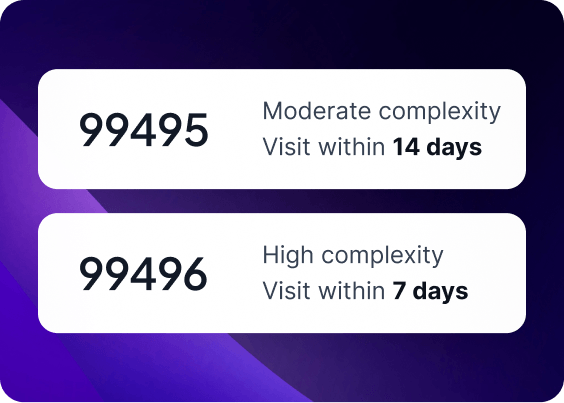
TCM CPT codes are the two Medicare billing codes, 99495 and 99496, that are used to report Transitional Care Management services after a patient is medically discharged from an inpatient setting and hospital outpatient observation. Both of the codes cover the same 30-day service period and the same core Transitional Care Management activities. The code you bill depends on two factors: the complexity of the patient’s medical decision-making, as well as whether the required face-to-face visit takes place within 14 days (99495) or 7 days (99496). For a total overview of how Transitional Care Management works, see our Definitive Guide to Transitional Care Management.
99495 vs. 99495: The Key Differences
The difference between CPT 99495 and CPT 99496 comes down to medical decision-making complexity, and how quickly the patient is seen after medical discharge.

Both codes require the same 30-day Transitional Care Management service. The difference is the patient’s clinical complexity and whether the face-to-face visit occurs within 14 days or 7 days.
CPT 99495 Explained
CPT 99495 covers Transitional Care Management for patients requiring moderate-complexity medical decision-making and a face-to-face visit within 14 days of medical discharge. National Medicare reimbursement averages around $220 in 2026. It is generally appropriate for patients who need coordinated follow-up and medication management.
CPT 99496
CPT 99496 covers Transitional Care Management for patients requiring high-complexity medical decision-making and a face-to-face visit within 7 days of medical discharge. National Medicare reimbursement averages around $298 in 2026. It’s intended for higher-risk patients whose recovery requires faster clinical assessment and closer oversight than those billed under 99495.
What Every TCM Claim Requires
Whether you bill 99495 or 99496, every Transitional Care Management claim must meet the same three core requirements during the 30-day service period that begins on the date of hospital discharge.
Interactive Contact Within 2 Business Days
A member of the care team must make interactive contact with the patient or caregiver within two business days of their discharge event by phone, in person, or electronically. The attempt needs to be documented. If two documented attempts are made within the required timeframe, but patients cannot be reached, the service might still be billable if all other TCM requirements are met.
A Face-to-Face Visit
The billing provider must complete a face-to-face visit within 14 days (99495) or 7 days (99496) of medical discharge. In many cases, this visit can be provided via telehealth, subject to current CMS rules
Non-Face-to-Face Services and Medication Reconciliation
Throughout the 30-day service period, the care team coordinates follow-up care, reviews hospital discharge information, manages referrals, and performs medication reconciliation no later than the date of the face-to-face visit. Much of this work might be completed by qualified clinical staff under general supervision as applicable by state law.
How to Choose Between 99495 and 99496
Choosing the right code depends on the level of medical decision-making. Greater complexity is typically associated with higher risk clinical diagnoses, greater amounts of information to review, and a higher risk of complications or adverse outcomes. Providers need to refer to the latest AMA guidelines for the complete decision-making criteria.
As a practical rule of thumb, patients who are at moderate risk of morbidity or mortality, and clinically require a face-to-face visit within 7 days, typically meet the requirements for 99496. Those that can safely be seen within 14 days are more likely to qualify for 99495. Whatever code is selected, the documented medical decision-making should clearly support the level billed.
TCM Billing Rules and Common Mistakes
The majority of TCM claim denials can often come down to just a few errors. It’s important to keep the following rules in mind when you are trying to ensure your claims are billed in the right way.
Billing Rules:
- Make sure you follow the 1:1:1 rule. This is where one provider bills one TCM code for one patient during a single 30-day service period.
- Bill after the 30-day period ends, using the date of the face-to-face visit as the date of service.
- Don’t bill a separate E/M visit for the required TCM face-to-face encounter, as it’s included in the service.
- If a patient is readmitted during the 30-day period, only one TCM claim applies for that episode of care.
Common Reasons Claims Are Denied
Before you submit a claim, make sure you check that you haven’t”
- Missed the required initial contact within two business days
- Scheduled the face-to-face visit outside the required timeframe
- Submitted the claim before the 30-day service period ended
- Forgotten to document the medical decision-making supporting the billed code
How Dimer Health Supports TCM Delivery
Being able to run a successful TCM program means much more than simply understanding the billing rules. Dimer Health helps Advanced Practice providers do exactly that, via their physician-led care team, as well as Dimer Connect. We coordinate patient outreach, timely follow-up visits, medication reconciliation, and ongoing care coordination across the 30-day recovery process.
Dimer Health provides a structured, repeatable workflow, helping patients receive the support they need, as well as reducing burden on providers.
Dimer Health has completely transformed the post-discharge event care by reducing hospital readmissions by 67%, and connects patients with their first appointment in less than 24-hours. It also supports more than 3,000 patients across multiple states, including New York, New Jersey, Pennsylvania, Ohio, North Carolina, Florida, Texas, and California.
Bill TCM With Confidence
Making the decision between 99495 and 99496 comes down to two key factors, medical decision-making complexity, and how long after medical discharge patients need to be seen.
Generally speaking, patients at moderate risk of morbidity or mortality, who clinically require a face-to-face meeting within 7 days are best suited to 99496. Conversely, those who can be safely seen within 14 days are more likely to qualify for 99495.
Be sure to meet the required timelines, document the service thoroughly, and complete the necessary Transitional Care Management activities to ensure that claims remain accurate.
If your practice wishes to focus on patient care as opposed to managing each step of the TCM workflow, Dimer Health can deliver physician-driven Transitional Care Management from the discharge process through recovery.
FAQs
What are the TCM CPT codes?
The TCM CPT codes are 99495 and 99496. Medicare uses both to report transitional care management services provided during the 30 days after a patient is medically discharged from an inpatient setting.
What is the difference between 99495 and 99496?
The difference is medical decision-making complexity and visit timing. 99495 applies to moderate-complexity cases with a face-to-face visit within 14 days of medical discharge. 99496 applies to those patients at moderate risk of morbidity and mortality, who require a face-to-face visit within 7 days of medical discharge.
How much do 99495 and 99496 reimburse in 2026?
National Medicare reimbursement averages around $220 for 99495 and $298 for 99496 in 2026. Rates vary by region, so check the CMS Physician Fee Schedule for the exact amount in your area.
Who can bill for TCM services?
Only the billing provider who manages the patient's care after discharge can report a TCM code. Under the 1:1:1 rule, just one provider bills one TCM code for one patient during a single 30-day service period.
When do you bill a TCM code?
You bill after the 30-day service period ends. Submitting the claim before the period closes is one of the most common reasons TCM claims get denied.
What date of service do you use for TCM billing?
The date of service is the date of the face-to-face visit, not the medical discharge date or the end of the 30-day period.
Can you bill TCM and chronic care management in the same month?
TCM and CCM overlap rules have changed in recent years, so check current CMS guidance before billing both in the same period.
Can the TCM face-to-face visit be done by telehealth?
In many cases, yes, subject to current CMS rules. The visit still can't be billed separately as an office visit, since it's included in the TCM service.
What happens if the patient is readmitted during the TCM period?
Only one TCM claim applies for that episode of care, even if the patient is readmitted during the 30-day window.
What documentation is required to bill TCM?
You need documentation of the interactive contact attempt within 2 business days of hospital discharge, the face-to-face visit, medication reconciliation, and the medical decision-making that supports the code billed. Thin documentation of decision-making is one of the most common causes of denials.