

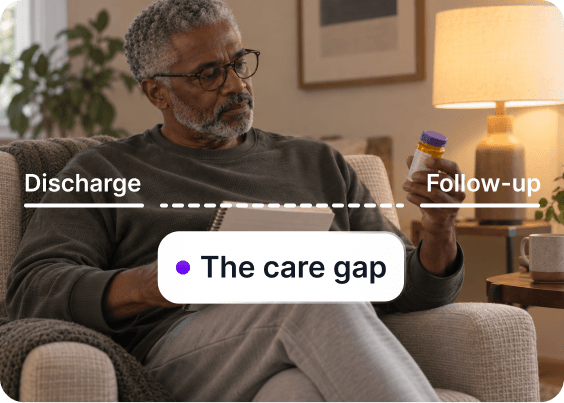
The post-discharge care gap is the period after a patient leaves the hospital when no single team is responsible for managing their recovery. But it is also the point at which too many recoveries begin to break down. A landmark New England Journal of Medicine fee-for-service patients found that more than 19.5% of patients were readmitted within 30 days of discharge, highlighting just how vulnerable this recovery window is.¹
Most people leave the hospital with discharge paperwork, new medications, follow-up appointments to arrange, and a raft of questions they don’t think of until after they get home. The gap between hospital and home is typically where these questions go unanswered, warning signs are missed, and recovery becomes more challenging than it needs to be. Understanding the causes of this gap is the first step toward closing it.
What the Post-Discharge Care Gap Is
The post-discharge care gap is the period after a hospital stay when a patient no longer has the hospital’s oversight, but has yet to be picked up by any team responsible for guiding their recovery. Although patients are technically discharged, they often are yet to reconnect with their primary care provider, or receive the support needed to navigate recovery safely at home.
Too often, medical discharge is treated as the finish line. In reality, it marks the beginning of one of the highest-risk periods in a patient’s healthcare journey. Medications might have changed, new symptoms can develop, follow-up appointments might need to be arranged, and patients are expected to manage complex recovery plans on their own, without guidance. When no one coordinates this recovery window, avoidable complications are far more likely to occur.
Key Figures
- 19.6% of Medicare fee-for-service patients were readmitted within 30 days of medical discharge in the landmark study.¹
- Unplanned hospital readmissions cost Medicare close to $17 billion every year.¹
Why the Gap Exists
The post-discharge care gap is not caused by a single failure, but by several breakdowns that can occur once the patient leaves the hospital. Although hospital discharge often marks the end of a significant stage of care, recovery is only starting, and without coordinated support, patients find themselves left alone to manage complex medical needs.
No One Owns the Recovery
When a patient is medically discharged, the hospital’s role is more or less complete. Their primary care provider might not see them for days or weeks, while specialists are focused on their specific condition, instead of overall recovery.
Follow-Up That Never Happens
The first follow-up appointment is often one of the key steps in recovery, but it doesn’t always happen. Research shows that around half of Medicare patients who were readmitted within 30 days of a medical discharge did not see a physician between leaving the hospital and returning.²
Medication Confusion
Many patients wind up leaving the hospital with new prescriptions, changed dosages, or instructions to stop taking certain medications. Without clear guidance, it can be a challenge to understand which medicines they should be taking, when to take them, or how they impact your existing treatment plans. Medication reconciliation helps identify and resolve these issues, but when it doesn’t happen, medication errors can be one of the biggest causes of avoidable readmissions.
No One Watching for Warning Signs
Many complications start with subtle changes rather than sudden emergencies. Increasing shortness of breath, swelling around a surgical incision, worsening pain, or unexpected side effects can all be managed effectively if someone identifies them early. Without proactive monitoring during the recovery window, these warning signs can go unnoticed until they require another visit to the emergency department.
Barriers at Home
Recovery is dependent upon much more than just medical treatment alone. Transportation difficulties, medication costs, limited health literacy, living alone, and lack of caregiver support can all contribute to difficulties following a discharge plan. These are challenges that impact patients of all ages, but they are very common among older adults, and those with fewer financial or social resources.
What the Gap Costs
The post-discharge care gap has consequences for everyone involved; patients, hospitals, payors, vendors, and the wider healthcare system at large,
Patients are impacted by potentially another hospital stay, slower recovery, added stress, and higher risk of long-term complications. Recovery is much more challenging when preventable setbacks interrupt the healing process.
For hospitals and health systems, avoidable readmissions can lead to financial penalties through the CMS Hospital Readmissions Reduction Program (HRRP), while also impacting patient outcomes and quality metrics.
For payors and the healthcare system, avoidable readmissions contribute billions of dollars in unnecessary healthcare spending annually, highlighting the significant financial impact of fragmented post-discharge care.
Although these costs impact different groups in different ways, they often stem from the same underlying problem: the recovery window after hospital discharge is one of the most vulnerable stages of care, but is often the period with the least coordinated clinical support.
Which Patients are Most at Risk?
Although any patient can experience complications after leaving the hospital, the post-discharge gap does not affect everyone the same. Some patients face far greater risk of readmission because their recovery is more complicated, and they sometimes have additional barriers to managing care at home.
- Patients recovering from surgery often need close monitoring for infections, wound complications, pain management, and mobility issues during the first weeks of recovery.
- People living with multiple chronic conditions need to balance several health concerns at once, making medications, follow-up care, and symptom management more of a challenge.
- Older adults are more likely to experience changes in mobility, cognition, or overall health after medical discharge, increasing the likelihood that small problems become larger.
- Patients taking complex medication regimens face risk of missed doses, medication errors, and harmful side effects when facing post-discharge treatment plans.
- Patients who already have experience with previous hospital readmissions are often at increased risk of returning again because many of the underlying challenges that impact their recovery remain unresolved.
The vulnerability of this window is reflected in long-term outcomes. And the results from New England Journal of Medicine highlight how important these early weeks immediately following medical discharge can be.
How to Close the Post-Discharge Care Gap
Closing the post-discharge care gap requires more than simply scheduling appointments. It needs a coordinated, connected approach that supports patients throughout the recovery window, ensuring that questions are answered and care can continue beyond the hospital walls.
The most effective post-discharge care models share several characteristics. They establish one physician-led team that is responsible for coordinating the recovery window, arrange follow-up care before the patient leaves the hospital, perform medication reconciliation to reduce confusion, proactively check in with patients instead of waiting for them to call, and providing a clear way to get in touch with clinicians if symptoms change.
This is precisely what transitional care and post-discharge care are designed to do. Instead of replacing hospitals, specialists, or primary care providers, these models connect each stage of the patient journey, helping patients recover safely until they’re ready to transition back to their long-term healthcare team.
Research consistently points to the same conclusion: many avoidable readmissions are linked to breakdowns in communication, follow-up, medication management, and ongoing monitoring. And these are the gaps that post-discharge care is designed to address.
How Dimer Health Closes the Gap
Dimer Health was designed and built precisely to close the post-discharge care gap. Through an always-on physician-led care team, Dimer Health provides short-term clinical support throughout the recovery window, helping patients navigate the critical days and weeks after leaving the hospital before transitioning them back to their primary care provider.
Instead of waiting for patients to reach out when something has gone wrong, Dimer Health takes a proactive approach. The clinical team coordinates medication reconciliation, symptom monitoring, follow-up care, and regular patient outreach, helping to identify potential complications before they become emergencies, and keeping patients connected throughout recovery.
This care experience is delivered via Dimer Connect, Dimer Health’s connected post-discharge care platform that brings medical discharge instructions, personalized recovery plans, medication guidance, symptom monitoring, appointment scheduling, and clinical access together in one connected experience, helping patients navigate recovery while giving care teams the visibility to monitor progress, coordinate outreach, and intervene when needed.
Dimer Health patients have access to AiME, Dimer Health’s AI recovery care companion that lives inside the Dimer’s web-based platform. AiME differs from general-purpose AI chatbots because it is informed by the patient’s personal recovery plan, medical history, medications, and care instructions, allowing it to provide personalized guidance throughout the recovery process. Whenever patients’ questions or concerns need human clinical judgment, Dimer Health’s licensed team steps in to provide physician-led guidance and support.
Currently, Dimer Health provides post-discharge care across New York, New Jersey, Pennsylvian, Ohio, North Carolina, Florida, Texas, and California, with licensing being pursued across other states. Dimer Health helps health systems across the United States extend care beyond hospital discharge, contributing to reductions in hospital readmissions
Closing the Gap Starts Before the Patient Leaves
Recovering after a hospital stay shouldn’t mean having to navigate your medications, appointments, or new symptoms alone. With the right help and support in place before the discharge process, patients can leave the hospital feeling empowered and knowing that they have a clinical team to guide them through the recovery window.
For hospitals, health systems, and providers, the post-discharge care gap is a coordinated challenge that can be addressed. Extending physician-led support beyond medical discharge helps improve continuity of care, reduce avoidable readmissions, and create better outcomes for patients and healthcare organizations.
FAQs
What is the post-discharge care gap?
The post-discharge care gap is the period after hospital discharge when patients no longer have hospital oversight but have not received coordinated recovery support.
Why are so many patients readmitted after leaving the hospital?
Many readmissions occur because of gaps in follow-up care, medication management, symptom monitoring, and care coordination during recovery.
What percentage of patients are readmitted within 30 days?
A landmark New England Journal of Medicine study found that 19.6% of Medicare fee-for-service patients were readmitted within 30 days of medical discharge.
What are the most common causes of hospital readmissions?
Common causes include missed follow-up appointments, medication confusion, unmanaged symptoms, poor care coordination, and barriers to following recovery plans.
Which patients are most likely to be readmitted?
Older adults, patients with multiple chronic conditions, complex medication regimens, recent surgery, or previous readmissions generally face the risk
How much do avoidable readmissions cost?
Unplanned Medicare readmissions are estimated to cost approximately $17.6 billion each year.
How can hospitals reduce readmissions?
Hospitals can reduce readmissions through better medical discharge planning, medication reconciliation, proactive follow-up, and coordinated post-discharge care.
What is transitional care management?
Transitional Care Management is a Medicare service that supports patients during the transition from hospital to home after medical discharge.
How is post-discharge care different from home health?
Post-discharged care coordinates the entire recovery process, while home health delivers specific physician-ordered skilled services.
Does Dimer Health reduce hospital readmissions?
Yes. Dimer Health’s physician-led post-discharge care model has reduced hospital readmissions by 67% while improving continuity of care during recovery.
Sources:
1. New England Journal of Medicine
2. New England Journal of Medicine (2)