


Transitional Care Medicine (TCM) is the coordinated care patients receive during the 30 days after leaving the hospital, helping prevent complications, improve recovery , and reduce avoidable readmissions. It’s a clinical care model designed to support patients through the post-discharge recovery window and a Medicare-reimbursable service with specific billing requirements and CPT codes.
This guide explains everything you need to know about Transitional Care Management, including how the 30-day process works, the CPT codes, who qualifies, who can bill for TCM services, and the best practices for delivering successful transitional care.
What is Transitional Care Management?
Transitional Care Management (TCM) is a set of coordinated services that supports patients during the 30 days after they are medically discharged from an inpatient setting back into the community. Its purpose is to help patients recover safely by identifying complications early, reconciling medications, coordinating follow-up care, and reducing the risk of avoidable hospital readmissions during one of the most vulnerable stages of recovery.
TCM exists because leaving the hospital is not the end of a patient's care journey, but the start of a critical recovery period. During these first few weeks, patients often have new medications, follow-up appointments to arrange, and questions surrounding recovery. Transitional Care Management helps ensure someone is actively coordinating that process as opposed to leaving patients to manage this alone.
Importantly, Transitional Care Management is two things at the same time. It’s a proven clinical model for improving continuity of care after hospital discharge, and it is also a Medicare-reimbursed service with its own billing requirements and CPT codes (99495 and 99496) for eligible providers.
Key facts
- Service period: Covers the 30 days following medical discharge from an inpatient setting.
- Inpatient psychiatric hospital.
- Inpatient rehabilitation facility.
- Long-term care hospital.
- Skilled nursing facility.
- Hospital outpatient observation or partial hospitalization.
- Partial hospitalization at a community mental health center.
- CPT codes: 99495 (moderate complexity) and 99496 (high complexity).
- Primary goal: Reduce avoidable hospital readmissions through coordinated follow-up, medication reconciliation, and proactive recovery support.
Why Transitional Care Management Matters
The weeks immediately after hospital discharge are one of the highest-risk periods in a patient’s recovery. Medications change, follow-up appointments need to be arranged, new symptoms can develop, and patients are often expected to manage complex recovery plans on their own. In the landmark New England Journal of Medicine study of Medicare fee-for-service patients, 19.6% were readmitted within 30 days of the discharge process. This highlights the vulnerable nature of this recovery window.
Transitional Care Management is the structured response to this challenge. Rather than waiting for patients to seek help when something goes wrong, TCM provides coordinated follow-up medication reconciliation, proactive outreach, and ongoing clinical oversight throughout the first 30 days after the discharge event.
Research has shown that well-designed Transitional Care Management programmes can reduce hospital readmissions, improve patient outcomes, lower healthcare costs, and, in some studies, reduce mortality among high-risk patients. Before publication, these outcome statements should be supported with the most current published evidence and systematic reviews.
If you want a closer look at why patients are readmitted after leaving the hospital, read our guide to The Post-Discharge Care Gap: Why 1 in 5 Patients are Readmitted, which explores the underlying causes in more detail.
How Transitional Care Management Works
Transitional Care Management starts the day a patient is medically discharged from an inpatient setting, and it continues for 30 days. Medicare sets specific requirements for delivering and billing TCM services, all designed to ensure patients receive timely, coordinated support throughout their recovery. Providers should always confirm the latest CMS guidance before delivering or billing Transitional Care Management services.
Interactive Contact Within 2 Business Days
The first step is making initial contact with the patient or their caregiver within two business days of hospital discharge. This contact may take place by telephone, in person, or through approved electronic communication and is intended to identify immediate concerns, answer questions, and begin coordinating the patient’s recovery.
If the initial attempt fails, it still needs to be documented. Prompt outreach helps to identify potential problems early, and establishes the relationship that supports the remainder of the 30-day care period.
The Face-to-Face Visit
Every Transitional Care Management service includes a face-to-face visit with the billing physician or another qualified healthcare provider. The timing is dependent on the complexity of the patient’s medical decision-making:
- Within 14 days for moderate-complexity cases (CPT 99495)
- Within 7 days for high-complexity cases (CPT 99496)
In a lot of situations, this visit could be provided through telehealth, subject to current Medicare rules. Medication reconciliation must be completed no later than the date of this face-to-face visit, ensuring the patient’s medications are accurate, understood, and safe.
Non-Face-to-Face Care Across the 30 Days
The face-to-face visit is only one part of Transitional Care Management. Throughout the remainder of the 30-day service period, the care team continues coordinating the patient’s recovery through a range of non-face-to-face services.
These activities might include reviewing hospital discharge records, reconciling medications, scheduling specialist and primary care follow-up appointments, connecting patients with community resources, educating patients and caregivers, monitoring recovery, and responding to new concerns as they arise. Much of this work can be carried out by clinical staff under the supervision of the billing providers.
This ongoing coordination is what makes Transitional Care Management effective. As opposed to treating hospital discharge as the end of care, it provides structured support across the recovery window, helping patients recover safely while reducing the risk of avoidable complications and hospital readmissions.
TCM CPT Codes and Reimbursement: 99495 vs. 99496
Transitional Care Management has two Medicare billing codes, each based on the complexity of the patient’s medical decision-making, as well as the timing of the face-to-face visit. Choosing the right code is vital for compliance and reimbursement.
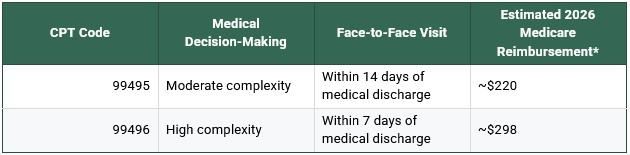
Both codes cover the full 30-day Transitional Care Management service period. The reimbursement reflects the ongoing coordination, communication, medication management, and clinical oversight that occurs across the patient’s recovery journey.
One of the most important billing principles to remember is the 1:1:1 rule:
- One provider
- One TCM code
- One patient
- All per 30-day service period
Only one eligible provider can bill Transitional Care Management services for a patient during each 30-day episode of care.
For a more detailed breakdown of documentation requirements, billing rules, and coding scenarios, check out our dedicated guide to Transitional Care Management (get pillar link).
Who TCM is For and Who Can Deliver It
Not every patient qualifies for Transitional Care Management, and not every healthcare professional can bill for it. Understanding the eligibility requirements helps ensure patients receive the right level of support, while providers remain compliant with Medicare billing rules.
Which Patients Qualify
Transitional Care Management is intended for patients who have been medically discharged from an inpatient setting back into the community. This includes discharges from hospitals, skilled nursing facilities, observation stays, and certain other qualifying facilities, with the patient returning to a setting such as their own home, an assisted living community, or another residence.
Patients must require moderate or high-complexity medical decision-making during their recovery to qualify for TCM services.
For instance, a patient recovering from respiratory failure who needs medication adjustments and close follow-up might qualify as someone medically discharged who needs coordinated specialist appointments and ongoing recovery monitoring.
Which Providers Can Bill
Transitional Care Management can be billed by physicians and qualified non-physician practitioners, including nurse practitioners (NPs), physician assistants (PAs), clinical nurse specialists (CNSs), and certain certified nurse midwives as long as they meet Medicare’s billing requirements, and are legally authorized and qualified to provide the services under applicable state law.
Much of the ongoing non-face-to-face care can be carried out by qualified clinical staff under the billing provider’s supervision. Exactly who can provide that supervision depends on state scope-of-practice rules. However, the billing provider remains responsible for the face-to-face visit and overall Transitional Care Management service.
As with all TCM services, only one eligible provider may bill Transitional Care Management for a patient during a single 30-day service period. Providers always have to verify current CMS eligibility and billing requirements before they make claims.
The Benefits of Transitional Care Management
The critical recovery period for patients is the first 30 days after the discharge event, but this is also the highest-risk period. Consistency is key to TCM’s success, and, if implemented correctly, the benefits will extend well beyond the first follow-up appointment. Providing structured support all across the 30-day recovery window allows TCM to improve outcomes for patients, while also supporting providers, health systems, and payors.
For Patients
Patients benefit from TCM because it means they aren’t left to deal with and manage their recovery alone. Regular follow-up, medication reconciliation, coordinated appointments, and access to clinical guidance can help identify early problems in order to reduce the risk of avoidable complications.
For Providers and Practices
For physicians and healthcare practices, TCM supports better continuity of care while providing reimbursement for work that’s essential to safe and effective patient recovery. TCM is associated with lower readmission rates and improved patient outcomes.
For Health Systems and Payors
Perhaps the biggest benefit of TCM for health systems and payors is that a reduction in avoidable readmissions means better outcomes for patients, and lower healthcare costs as a result. Transitional Care Management helps close the gap in post-discharge care by helping ensure patients remain supported during the time-period when complications and unnecessary returns to hospital are most likely.
TCM vs. Other Care Models
Transitional Care Management is typically confused with other healthcare services because they all support patients once they leave the hospital. However, whilst there is a degree of overlap, each of the models serves a different purpose.
Transitional Care Management vs. Chronic Care Management
Transitional Care Management is a time-limited service that supports patients during the first 30 days following their medical discharge from the hospital. Chronic Care Management (CCM) provides ongoing monthly support specifically for those patients that have to live with multiple chronic conditions, and is not specifically tied to a recent hospital stay.
Transitional Care Management vs. Post-Discharge Care
TCM and post-discharge care are both focused on helping patients recover once they leave the hospital. However, the difference lies in the fact that TCM is specific to the CMS-defined service with its own billing requirements and CPT codes, while post-discharge care tends to be broader.
Transitional Care Management vs. Home Health
Home health provides physician-ordered skilled services such as wound care, physical therapy, or nursing visits for eligible patients. Transitional Care Management coordinates the patient’s overall recovery, including medications, follow-up care, communication, and care coordination. A lot of patients will benefit from receiving both services at the same time.
How to Run a Successful TCM Program
Delivering Transitional Care Management successfully requires a lot more than a simple understanding of the billing rules. The challenge is to build a consistent, repeatable process that provides the necessary support to each patient at the appropriate time.
Many programs struggle with the same operational challenges: reaching patients within two business days, scheduling the required face-to-face visit before the deadline, completing medication reconciliation accurately, coordinating follow-up care, and being able to maintain the relevant documentation to support Medicare billing.
The TCM programs that are the most successful are those that rely on clearly defined workflows, instead of expecting busy clinical teams to remember every requirement. Standardized processes, proactive patient outreach, and coordinated communication are crucial for providing patients with consistent support, while reducing administrative burden.
For a lot of companies, maintaining that level of coordination entirely in-house can be difficult. Working with a dedicated TCM partner helps providers and health systems deliver a consistent patient experience while meeting clinical and operational requirements more efficiently.
How Dimer Health Delivers Transitional Care Management
Dimer Health was built to deliver Transitional Care Management from start to finish. Through our physician-led care team, Dimer Health coordinates the entire 30-day recovery window, ensuring patients receive timely outreach, medication reconciliation, symptom monitoring, follow-up care, and ongoing clinical support once they leave the hospital.
Instead of waiting for patients to reach out when complications present themselves, Dimer Health takes a proactive approach. Patients get contacted quickly after hospital discharge, recovery gets monitored across the month, and concerns are identified before they become avoidable hospital readmissions.
The entire experience is powered by Dimer Connect, Dimer Health’s care coordination platform. Dimer Connect brings together individual patient recovery plans, including appointments, medications, symptom monitoring, and care coordination activities in one place, allowing the clinical team to manage each stage of the process.
Patients also have access to AiME, Dimer Health’s AI healthcare companion. Unlike a general purpose chatbot, AiME is informed by each patient’s recovery plan, medications, medical history, and care instructions, allowing it to answer questions and provide personalised support throughout the recovery process. Whenever clinical judgment is required, licensed members of the Dimer Health care team will step in to provide physician-led care, with patients able to reach the care team 24/7.
The results demonstrate the impact of taking this approach. Dimer Health has reduced hospital admissions by 67%, connects patients with their first provider visit within 24 hours of medical discharge, and maintains a 95% patient satisfaction rate. Today, Dimer Health delivers post-discharge care across New York, New Jersey, Pennsylvania, Ohio, North Carolina, Florida, Texas, and California.
Transitional Care Management Done Right
The month after leaving the hospital can feel overwhelming, but recovery does not need to be something that patients and caregivers are forced to navigate alone. Physician-led support and proactive follow-up provides a coordinated plan across the recovery window, and Transitional Care Management helps patients recover more safely.
For providers, practices, and health systems, TCM is one of the most effective ways of improving continuity of care while reducing avoidable readmissions. Instead of building every workflow from scratch, partnering with an experienced TCM provider can help organizations deliver high-quality care throughout this recovery period.
FAQs
What is transitional care management?
Transitional Care Management (TCM) is coordinated care provided during the 30 days after hospital discharge to help prevent avoidable readmissions.
What are the TCM CPT codes?
There are two TCM CPT codes, and they are 99495 for moderate-complexity cases, and 99496 for high-complexity cases.
What is the difference between CPT 99495 and 99496?
CPT 99495 requires a face-to-face visit within 14 days with moderate complexity medical decision making, while CPT 99496 requires the visit to occur within 7 days for high complexity medical decision making.
How long does transitional care management last?
Transitional Care Management covers the 30 days immediately following medicaldischarge from an inpatient setting, with Day 1 marking the date of the discharge event.
Who qualifies for transitional care management?
Patients may qualify for TCM after medical discharge from an eligible setting, including an acute care hospital, inpatient psychiatric hospital, skilled nursing facility, long-term care or rehabilitation facility, or certain observation and partial hospitalization settings, provided they require at least moderate complexity medical decision-making.
Who can bill for TCM services?
Physicians and qualified non-physician practitioners, such as nurse practitioners and physician assistants, can bill TCM services, provided they meet CMS requirements and applicable state scope-of-practice and supervision laws.
How much does Medicare reimburse for TCM?
Medicare reimbursement varies annually, but averages for 2026 are between $215-220 for CPT 99495 and $298 for CPT 99496.
Does transitional care management reduce readmissions?
Yes. Research has shown that well-delivered Transitional Care Management programs can reduce hospital readmissions, while also improving patient outcomes.
What is the difference between TCM and chronic care management?
TCM supports patients during the 30 days after hospital discharge, while Chronic Care Management is ongoing monthly support for long-term conditions.
Is transitional care management the same as post-discharge care?
No. Transitional Care Management is a specific Medicare-defined service, while post-discharge care is the broader clinical model of supporting patients once they have been medically discharged.
Can the TCM face-to-face visit be done by telehealth?
Yes. Current Medicare telehealth flexibilities allow eligible providers to deliver telehealth services through December 31, 2027. However, providers should continue to confirm that the TCM face-to-face visit aligns with the current CMS telehealth requirements.
Does Dimer Health provide transitional care management?
Yes. Dimer Health delivers physician-led Transitional Care Management through Dimer Connect, which combines proactive care coordination, clinical oversight, and ongoing patient support across the recovery window.